


When the Journey Doesn’t Go According to Plan
What my first Camino taught me about preparation, control, and learning to walk the road you’ve actually been given.
In 2023, I set out from Saint-Jean-Pied-de-Port to walk the Camino Francés to Santiago with a good friend.
Five hundred-ish miles.
Six weeks.
A year of planning.
And, like most good plans, at least a few assumptions about how the whole thing was going to go.
For me, that first Camino was mostly about adventure and challenge. I knew it would be hard. I expected sore muscles, long days, beautiful scenery, interesting people, and probably some moments when one or both of us wondered what on earth we had signed up for.
What I did not expect was for the plan to start unraveling on Day One.
The plan changes
Our first day took us over the Pyrenees on the Napoleon Route- a beautiful and demanding start to the Camino.
By late afternoon, a storm had rolled in. We were tired, wet, and trying to get off the mountain before dark.
On a steep, muddy descent toward Roncesvalles, my friend slipped and twisted her leg.
She managed to hobble the last little bit toward town. We iced it, she took some anti-inflammatories, and by the next morning it felt a little better.
So she did what determined people do when something hurts but they have a very big goal in front of them…
She tried to keep going.
For the next few days, we adjusted. She walked when she could. She taxied ahead when she couldn’t. She rested. She wrapped. She bought new shoes. She tried again.
Eventually, though, the pain became too much to ignore.
We went to a clinic to see a doctor who sent her to the hospital for an x-ray. I went ahead walking toward our next destination.
About an hour later, I got a text-“the” text.
Her foot was fractured in three places.
There was a fourth fracture extending up her shin.
She was in a cast, and the doctor strongly recommended she return home and see a surgeon.
I remember reading the message and, after taking it in for a minute, realizing:
Holy crap, I’m going to do this alone.
One conversation that mattered more than we knew
Thankfully, before we ever left home, we had talked about something that seemed fairly mundane at the time.
What if one of us needed a rest day?
What if somebody got sick?
What if one person wanted or needed to take a taxi while the other wanted to walk?
We agreed ahead of time that neither of us would expect the other to stop walking simply because one of us couldn’t.
I’m pretty sure we were imagining a blister.
Maybe the flu.
We definitely weren’t imagining four fractures and a flight home.
But wow…did that conversation matter!
We had made a decision when neither of us was scared, hurt, exhausted, disappointed, guilty, or grieving the loss of a dream.
So when the situation became far bigger than we had imagined, we weren’t also trying to negotiate the basic question of whether I should continue.
That agreement did not make the situation easy.
But I’m convinced it saved my Camino.
There’s a lesson there that extends well beyond walking across Spain:
Some of the best decisions are the ones we make before emotion is running the meeting.
If there’s something reasonably predictable that could create confusion, disappointment, or conflict later, sometimes the wisest thing we can do is talk about it while everyone still has a clear head.
Preparation cannot prevent every hard thing.
But it can keep a hard thing from becoming even harder.
And then there was the part I couldn’t prepare for
Knowing I would continue and actually continuing were two different things.
I knew how heartbreaking it was for my friend to go home. This Camino had mattered deeply to her, and although she wanted me to keep walking, I felt plenty of guilt about being the one who still could.
And suddenly, almost everything practical was mine to figure out too.
Accommodations had been booked under her name.
She had done much of the original organizing.
I didn’t even have a Camino app or guidebook 🤦🏼♀️and our printed, day-by-day instructions were proving to be…let’s call them less helpful than one might hope. 😉
For the first several days after she left, I moved through the Camino with a kind of dazed tunnel vision.
Follow the yellow arrows.
Get to the next town.
Find the accommodation.
Figure out the luggage.
Keep going.
I wasn’t exactly falling apart.
But I also wasn’t really there.
I was accomplishing the Camino.
And then, gradually, something shifted.
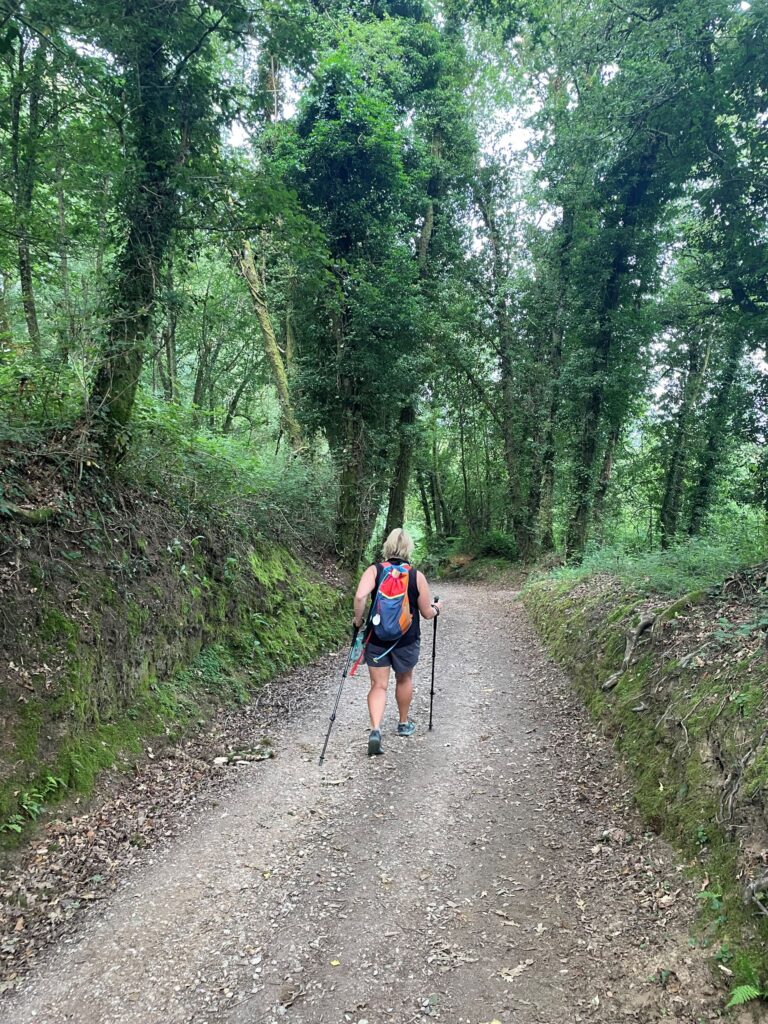
I stopped trying to get through it
I slowed down.
I noticed more.
I stopped moving as though I was in some invisible race toward the next reservation.
I started becoming much more present…
To the road.
The landscape.
The conversations.
The people.
God.
And something else became increasingly clear:
Although I was walking alone, I was never actually alone.
Faith was a significant part of why I wasn’t afraid to continue by myself. I knew I wasn’t really by myself- and never am.
But God also had a rather beautiful way of making that visible.
People seemed to appear at exactly the right times.
A brother and sister I met on the Meseta welcomed me into their days of walking, meals, and sightseeing almost immediately.
Two wonderful Australian women regularly invited me to meals and introduced me to other pilgrims.
There were people who became friends in the amount of time it takes to walk a few kilometers together.
And then, on the day I walked into Santiago, a couple I had met earlier in the journey popped back into my Camino seemingly out of nowhere.
After all those miles, I had wonderful people beside me with whom to share the arrival.
God provided beautifully.
Not by restoring the journey I had expected.
By meeting me in the one I actually had.
The Camino I planned was gone
That realization has stayed with me.
The Camino I had planned was gone almost before it really began.
But the Camino I was given wasn’t lesser.
It was simply different.
And that distinction matters.
How often do we decide something has “gone wrong” primarily because it stopped matching the picture we had in our heads?
The job changed.
The relationship changed.
The timeline changed.
Someone disappointed us.
Our body didn’t cooperate.
The plan that made perfect sense on paper met real life.
And suddenly we are spending enormous energy trying to get reality to come back into alignment with what we thought was supposed to happen.
I’ve become increasingly aware that the idea that I have much control at all is an illusion. 😉
I can influence.
I can prepare.
I can make thoughtful decisions.
I can anticipate likely problems and build wise contingencies.
I can practice how I respond.
But ultimately, most of what goes down, I simply cannot control.
And I’m learning that it isn’t the problem I used to think it was.
Preparation still matters
I don’t think the lesson is, “Don’t bother planning because anything can happen.”
Quite the opposite.
Preparation mattered enormously on that first Camino.
The conversation my friend and I had before leaving mattered.
The mental fitness practices I had already been using mattered.
Being able to recognize when guilt, fear, hurt, or judgment was narrowing my thinking- and then intentionally step back into a wider perspective- mattered.
Faith mattered.
Preparation gave me tools. It just didn’t give me control.
And isn’t that the healthier goal anyway?
Exchanging:
How do I make sure nothing goes wrong?
For:
How do I prepare myself to meet what actually comes?
With faith.
With perspective.
With resilience.
With flexibility.
With empathy for myself and others.
And with enough openness to consider that the road I didn’t plan may still have something very good waiting on it.
The road we’re actually given
That first Camino taught me far more than I expected it to.
Certainly not because everything worked out according to plan.
But specifically because it didn’t.
And somewhere along the way, I stopped trying quite so hard to walk the Camino I thought I was supposed to have…
and began paying attention to the one beneath my feet.
That lesson is now one of many shaping the LTR Camino Experience I’m developing for 2028.
We will prepare thoughtfully long before we arrive in Spain- not because preparation gives us control, but because it can give us greater capacity to meet what comes with faith, awareness, resilience, and intention.
Because something will undoubtedly go differently than planned.
And that doesn’t mean the experience has gone wrong.
It simply means there is a different road in front of us.
And we’ll be walking that one. 🙂
Buen Camino.
Curious about the LTR Camino Experience 2028?
Learn more about the experience and join the interest list here.

